
Logging for a new world

Do you really understand the events in your web apps? I can speak for myself: I don’t feel like I do, even though I’ve spent a lot of my life on understanding them.
The problem, to me, is that the type of events I personally care about are just so specific. There’s many cases where there is a “right” thing to track, but that thing is particular to an application or experiment. And since one-off metrics are annoying, they just don’t get built.
Unless … you could just write SQL, or have an LLM write SQL for you. That’s why I created deebeelog. You can go to the website and sign up for updates, but I don’t think of this as a “product” yet. For now, it’s a personal tool. I might release it in some form if there’s decent interest.
What is deebeelog? The simplest possible way to reasonably do logging:
You spin off events: Right now, only in Javascript, but could be anything
deebelog stores it and adds useful session information
Super-duper crucial: You can query tables directly
As this is set up, I can ask my LLM of choice to talk to this data. And since this schema is so minimal, this simply works.
Let’s look at a landing page I own and track it together (and btw, you might think it’s not a great landing page, I’d agree, and it’ll look quite different very soon).
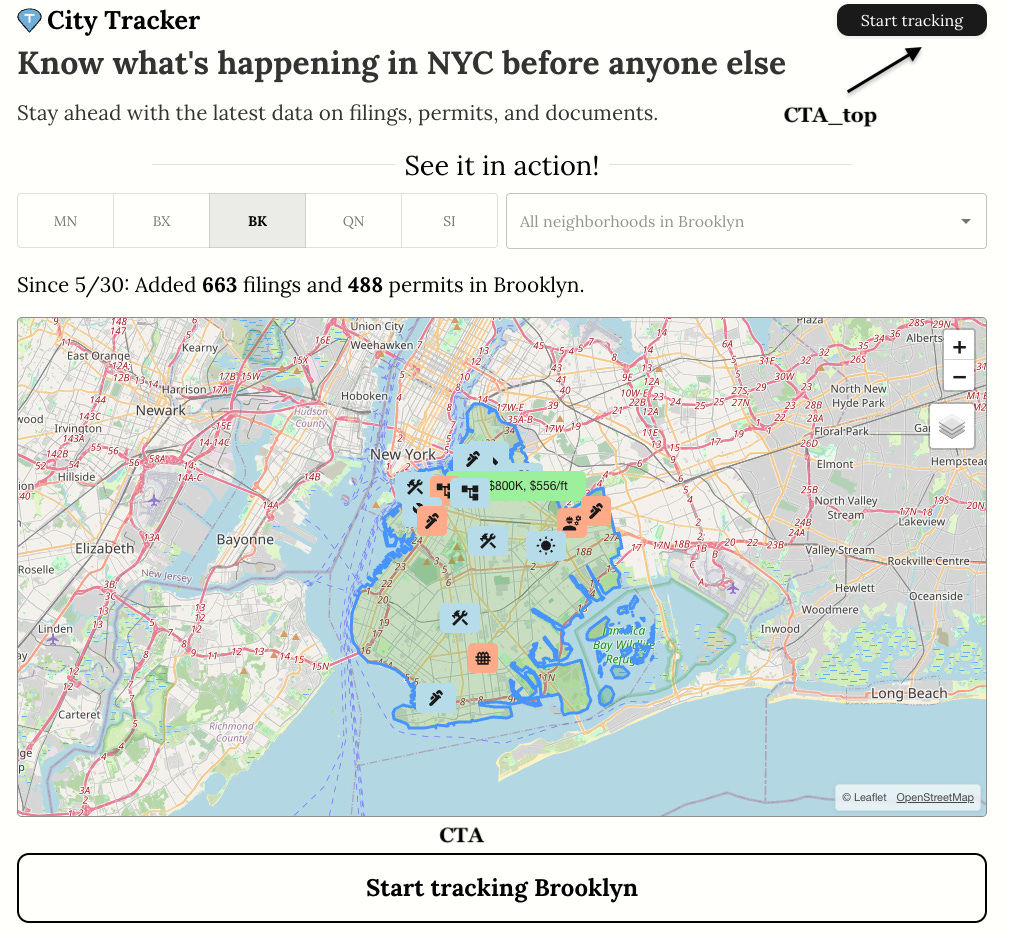
Here are some useful queries that will just work out of the box:
Show me the conversion rate for the “click_CTA_top”, grouped by platform
Give me the the latest 10 sessions with metadata
Show me the means of the landing page experiment for the “click_CTA_top” outcome.
An LLM will turn these into SQL, and I can run them from any dashboarding tool, currently I use Metabase for this. And this is nice, but it’s not yet magical.
The magic comes when we start asking a different type of question: “Given logging we have, what are valuable interactions we don’t track?” And in my case, I can promise you that there were lots of crucial clicks that I had simply … forgotten to track. And I don’t think that’s a personal flaw, it’s a human flaw: We’re bad at identifying things that we’re bad at identifying. Having a helper in the room helps us out.
Now, of course I can’t vouch that this way of working is transformative for you, we’re all quite unique in the things we care about. But for me it is, because it allows me to deeply care about user data and work towards truly figuring out the user intent.
“Given logging we have, what are valuable interactions we don’t track?”
How does using deebeelog help you answer this?